räsonanz Munich 2016
Georg Friedrich Haas
Georg Friedrich Haas was born in Graz spending his childhood in Vorarlberg, in the mountains – a landscape and atmosphere that left a lasting impression on him.
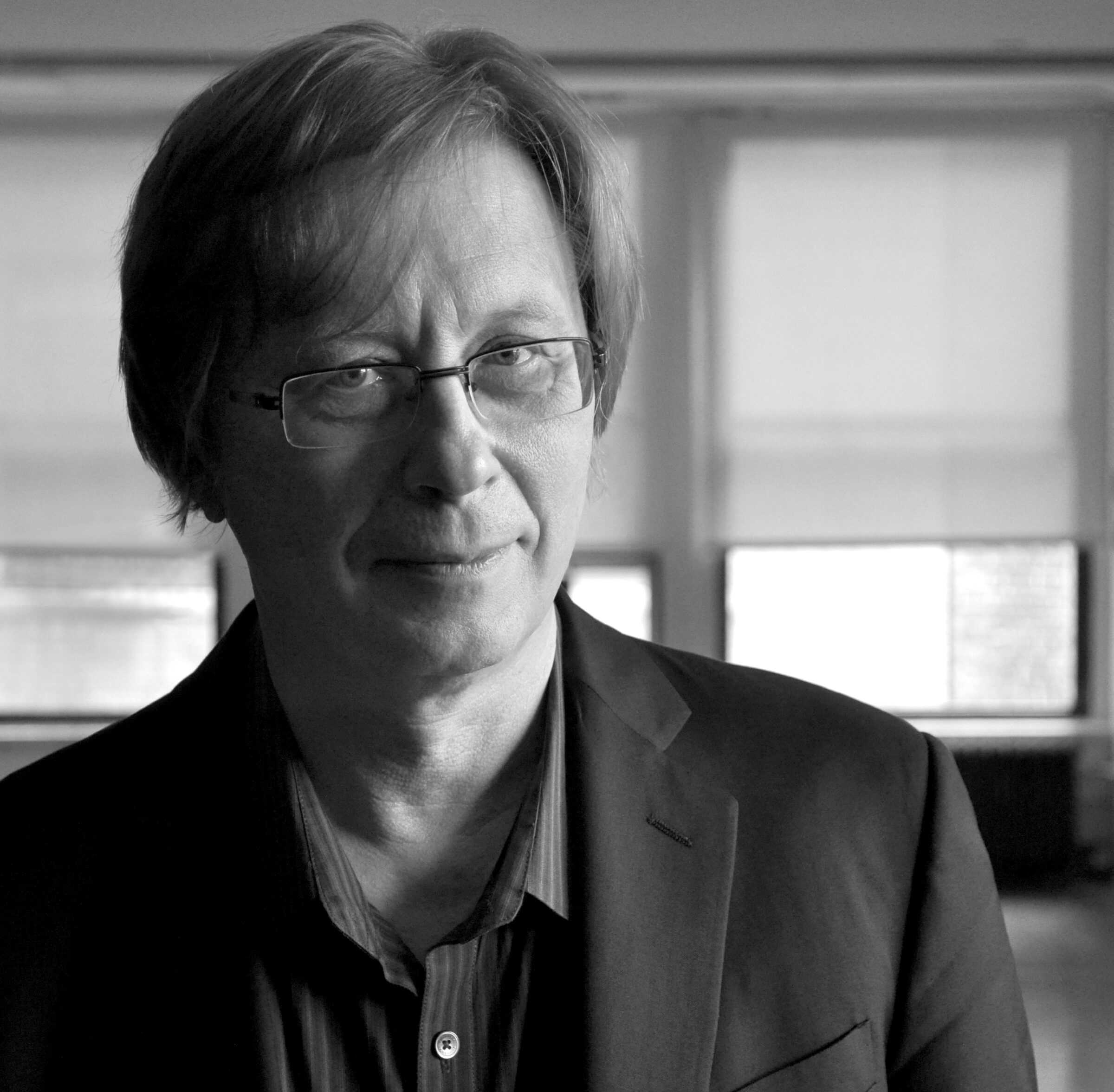
He returned to his native city to study under Ivan Eröd and Gösta Neuwirth and later in Vienna, under Friedrich Cerha. Cerha and Haas’ mutual admiration has lasted until today and is something often referred to by both composers. More recently Cerha, the doyen of Austrian composers, nominated his former student for the Grand Austrian State Prize that was duly presented to Haas in 2007.
However, the road to this success was a long and stony one.

Georg Friedrich Haas speaks openly of the years of “total failure” – an experience that reinforced his basic pessimistic stance. Success, when it did gradually emerge, only mitigated his pessimism but could never wholly eliminate it.
It is therefore no coincidence that the night, darkness, the loss of illusions played such a great role in his work (such as in his Hölderlin opera Nacht, 1995/1998) – indeed it is only very recently that light has illuminated his music. Nevertheless, considerable importance is attached to light as an integral part of his compositions, designed by artists especially for his music (in vain, 2000, and in particular Hyperion, a Concerto for Light and Orchestra, 2006). However, the light that later illuminated his music as opposed to darkness and the night probably only emerged as late as 2006 in his work Sayaka for percussion and accordion.
Georg Friedrich Haas is known and respected internationally as a highly sensitive and imaginative researcher into the inner world of sound. Most of his works (with the notable exception of the Violin Concerto, 1998) make use of microtonality whose magical world of sounds sends listeners into raptures.
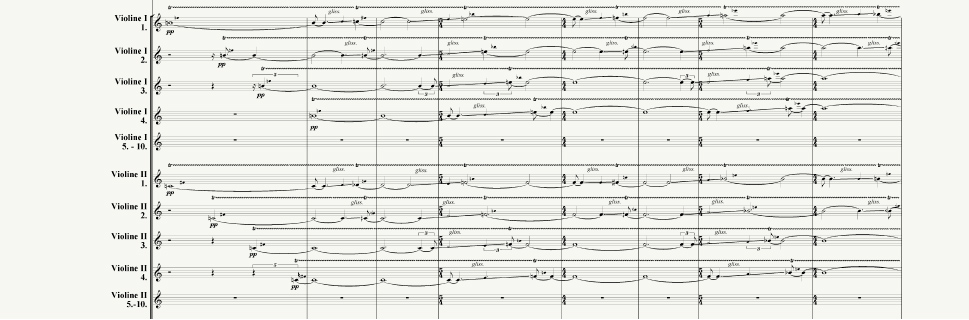
Haas has subjected microtonality to thorough examination – in the wake of Ivan Wyschnegradsky and Alois Hába – and has lectured on the subject in several European countries. In 1999 he was invited by the Salzburg Festival to give a talk under the title Beyond the Twelve Semitones, with the subtitle “Attempt at a Synopsis of Microtonal Composition Techniques”. In the last paragraph, he writes:
Micro counts as ‘tonality’ only in contrast with ‘normal tonality’ in its role as a system of reference. Where this system of reference has become obsolete, the notion of ‘microtonality’ has been replaced by the free decision of the individual composer in his use of pitch as his material.
In each new work, Haas enters uncharted territory, but his music is firmly rooted in tradition. His profound admiration for Schubert has found moving expression in his Torso of 1999/2001, an orchestration of the incomplete Piano Sonata in C major, D 840, an image of the tragic figure of Franz Schubert. Haas paid respect to Mozart not only in his … sodaß ich’s hernach mit einem Blick gleichsam wie ein schönes Bild…im Geist übersehe, composed for string orchestra in 1990/1991, but also in his 7 Klangräume, 2005, meant to be interspersed with movements of Mozart’s Requiem fragment (that is, divested of the supplements provided by his pupils). In Blumenstück, 2000, for chorus, bass tuba and string quintet, one hears echoes of Beethoven (perhaps never intended by the composer). In the Concerto for Violoncello and Orchestra, 2003/2004, the solo instrument quotes a motif from Franz Schreker’s opera Der ferne Klang (“O Vater, dein trauriges Erbe”). Commissioned by the Gewandhausorchester Leipzig, Haas’ Traum in des Sommers Nacht (2009) is a tribute to Mendelssohn, drawing on motifs from works of that composer, masterfully woven into Haas’ own music.

The Cello Concerto, just as Wer, wenn ich schriee, hörte mich …, 1999, for percussion and ensemble, reflects Haas’s political commitment and his bitter realisation of his helplessness as a composer: there is no way his music could serve to better the world. The Percussion Concerto was written at the time of the Balkan war; when Haas heard aeroplanes flying overhead carrying their deadly burden, he asked himself whether anyone could hear him, if he were to cry out in protest against the war. The Cello Concerto begins with a scream in unbearable pain, followed by a section where the drumbeat conjures up the march rhythm of the Prussian army: a plea against fascism.
A daringly innovative composer of rich imaginative power, a homo politicus aware of his responsibilities as a citizen, Georg Friedrich Haas is one of the leading artists in Europe today.

1953 – Born in Graz on August 16
1972-79 – Studies at the Academy for Music and the Performing Arts in Graz: composition (amongst others under Ivan Eröd and Gösta Neuwirth), piano (Doris Wolf) and music pedagogy
Since 1978 – Teaching at the Graz Academy of Music (latterly counterpoint, contemporary composition techniques, analysis, introduction to microtonal music)
1981-83 – Postgraduate studies under Friedrich Cerha at the Vienna Academy of Music and the Performing Arts
1980/88/90 – Attends the Darmstadt Summer School
1991 – Participation in the “Stage d’Informatique Musicale pour Compositeurs” at the IRCAM in Paris
1992/93 – Fellowship for the Salzburg Festival
1992 – Sandoz Prize
1995 – Austrian Promotional Prize for Music
08/07/1998 – Stage premiere of the chamber opera Nacht at the Bregenz Festival
11/18/1998 – Ernst Krenek Prize of the City of Vienna for the chamber opera Nacht
1999 – Selected composer in the ‘Next Generation’ series at the Salzburg Festival
1999/2000 – Grant recipient of the German Academic Exchange Service (DAAD) in Berlin

2000 – Violin Concerto is “Selected Work” at the International Rostrum of Composers
08/14/2003 – Premiere of Die schöne Wunde, commissioned by the Bregenz Festival
10/19/2003 – Premiere of Natures mortes for Large Orchestra, commissioned by the Donaueschingen Festival
March 2004 – Festival Composer at “ars musica” in Brussels
06/16/2004 – City of Vienna Music Prize
07/09/2004 – Premiere of the Concerto for Violoncello and Large Orchestra, commissioned by Musica Viva Munich

August 2004 – Lecturer at the Darmstadt Summer School
2005 – German Record Critics’ Prize for the CD recording of the String Quartet No. 1 and 2 with the Kairos Quartett
04/25/2005 – Andrzej Dobrowolski Composition Award 2004 presented by the Province of Styria in Graz, Austria
07/03/2005 – Premiere of Ritual for 12 large drums and 3 wind orchestras, commissioned by Klangspuren Schwaz in cooperation with the Tyrolean Regional Exhibition and Alpinarium Galtür
2005 – 2013 – Teaches composition classes at the City of Basel Music Academy
Fall 2005 – Featured Composer Georg Friedrich Haas at Klangspuren Schwaz
12/04/2005 – Premiere of 7 Klangräume for choir and orchestra, commissioned by Stiftung Mozarteum, Salzburg, Austria
March 2006 – Festival Composer at the Borealis Festival in Bergen (Norway)
03/23/2006 – Premiere of Poème for large orchestra, commissioned by Cleveland Orchestra / Franz Welser-Möst
10/22/2006 – Premiere of Hyperion for light and orchestra, Donaueschingen Festival

05/13/2007 – Premiere of Bruchstück for large orchestra, commissioned by the Munich Philharmonic
11/07/2007 – Premiere of Concerto for Piano and Orchestra, Wien Modern in Vienna
11/28/2007 – Awarded the Grand Austrian State Prize from the Republic of Austria
2008 –Professor for Composition at Basel Music Academy
05/03/2008 – Premiere of Concerto for Baritone Saxophone and Orchestra
06/09/2008 – Premiere of Melancholia (opera), Opéra National de Paris
08/28/2009 – Premiere of Traum in des Sommers Nacht, Leipzig
01/15/2010 – Premiere of ATTHIS, Berlin
02/04/2010 – Premiere of La profondeur in Amsterdam

10/17/2010 – Premiere of limited approximations for 6 microtonally tuned pianos and orchestra at the Donaueschingen Music Festival
Composition Prize of the SWR Symphony Orchestra Baden-Baden and Freiburg for limited approximations in Donaueschingen
10/22/2010 – Premiere of Arthur F. Becker (od. Buhr?)
11/26/2010 – Premiere of “… damit … die Geister der Menschen erhellt und ihr Verstand erleuchtet werden …” for ensemble, Basel
02/04/2011 – Premiere of String Quartet No. 6
March 2011 – Member of the Austrian Artistic Senate
06/04/2011 – Premiere of chants oubliés for chamber orchestra
09/10/2011 – Premiere of String Quartet No. 7
12/18/2011 – Premiere of Mlake / Laaken
Summer 2011 – Composer-in-Residence at the Lucerne Festival

2012 – Member of the Berlin Academy of the Arts
03/17/2012 – Premiere of Duchcov in Munich
06/15/2012 – Premiere of “Ich suchte, aber ich fand ihn nicht” at musica viva in Munich
08/252012 – Premiere of “…e finisci già” at the Salzburg Festival
09/13/2012 – Premiere of Tetraedrite at the opening concert of Klangspuren in Schwaz
03/03/2013 – 2013 Salzburg Music Award
02/20/2014 – Premiere of dark dreams in Berlin (Berlin Philharmonic conducted by Simon Rattle)
03/28/2014 – Premiere of concerto grosso No. 1 in Munich
05/10/2014 – Premiere of concerto grosso No. 2 at the Tectonics Festival in Glasgow
2015 – Member of the Bavarian Academy of Fine Arts
10/21/2015 – Premiere of String Quartet No. 8 in Basel
04/26/2015 – Premiere of Saxophone Quartet in Basel

Publications: Academic essays on the works of Luigi Nono, Ivan Wyschnegradsky, Alois Hába and Pierre Boulez
Since August 16, 2013 Haas has been MacDowell Professor of Music at Columbia University, New York.