räsonanz Munich 2016
Pierre Boulez
Born in Montbrison (Loire) on March 26, 1925, Pierre Boulez was a composer, conductor, musical author and a key figure on the international music scene.
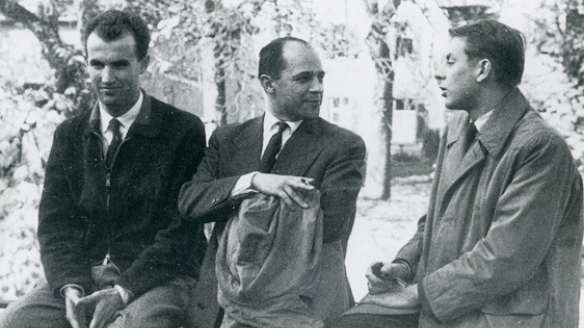
A living classic, his works have been a guiding light for composers around the world for over fifty years now. Some study his scores to see if they can adapt his ideas in their own work while others reject Boulez’ world in search of an idiom they can call their own, a new attitude to New Music. However, in both cases Boulez’ work forms a key pillar, visible for everyone exploring contemporary music in any shape or form.
At the start of his career, starting in the late 40s, Boulez was a rebel who made it clear he wanted nothing more to do with the musical tradition of the first half of the century. He rejected renovators like Arnold Schönberg (see his obituary Schönberg est mort) because he pinpointed in this inventor of twelve-tone music a proximity to predecessors like Brahms. He was only able to identify with Webern – indeed like many of his fellow lecturers at the Darmstadt Summer School.
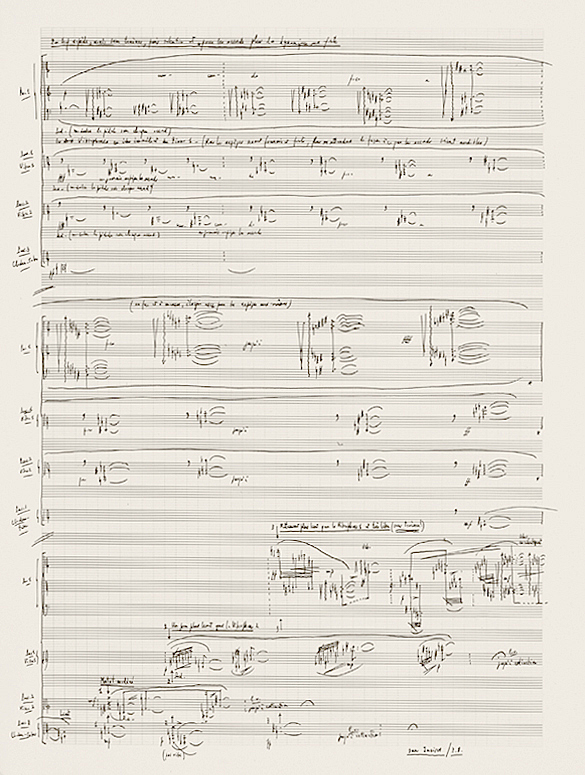
Soon Boulez began to work as a conductor. He planned new ensemble works with Domaine Musical – the ensemble he set up – and later in Baden-Baden. Initially he limited his repertoire to New Music to ensure his own compositions as well as those by other contemporary composers sounded authentic. Later with the increasing international acceptance of his struggle for New Music (whose key stages were his return to France where he founded the IRCAM and the Ensemble Intercontemporain with the support of President Pompidou) this rebellious stance was no longer necessary. He extended his repertoire to a previously inconceivable degree and conducted the likes of Mahler and Bruckner with top orchestras of the world who welcomed him with great enthusiasm – including the Vienna and Berlin Philharmonic. Boulez also wrote performance history with Leoš Janácek’s opera Aus einem Totenhaus staged with Patrice Chéreau.
Boulez is an important teacher. In recent times, as Head of the Orchestra Academy at the Lucerne Festival, he shared his unique knowledge with young, up-and-coming conductors.
New compositions leave his workshop all the time which are then immediately adopted – even snapped up – by ensembles and orchestras to soon become part of the international repertoire. A living classic.
1925 – Born in Montbrison (Loire) on March 26
First piano lessons, high school in Montbrison, later Saint Étienne
1941 – Attends special math classes in Lyon to prepare for the entrance exam for the École Polytechnique
1942 – Finally opts for a career in the music profession, moves to Paris
1944 – Harmony instruction under Olivier Messiaen at the Paris Conservatoire
1945 – Counterpoint under Andrée Vaurabourg-Honegger, composition under Messiaen, twelve-tone technique under René Leibowitz
1946–1955 – Head of stage music at Compagnie Renaud/Barrault
From 1950 – Performances of his works in Paris and Donaueschingen
1954 – Founding of the Concerts du Petit-Marigny under the patronage of Compagnie Renaud/Barrault, renamed Domaine Musical in 1955
1955–1960 – Analysis courses at the Darmstadt Summer School
1955 – Premiere of Le Marteau sans Maître under Hans Rosbaud in Baden-Baden
1957 – Boulez performs his Troisième Sonate for piano in Darmstadt
1958 – Premiere in Hamburg of two Improvisations sur Mallarmé that together with Improvisation III, Tombeau and Don form the orchestral work Pli selon pli – Portrait de Mallarmé completed in 1962
From 1960 – Analysis and composition courses in Basel
1963 – Visiting professorship at Harvard University, extensive conducting work

1966 – First appearance as conductor in Bayreuth for Parsifal, followed by Tristan und Isolde in Japan
1967–1972 – Regular concerts with the Cleveland Orchestra; Boulez hands over direction of the Domaine Musical to Gilbert Amy
1969–1975 – Chief Conductor at BBC Symphony Orchestra
1970–1977 – Chef Conductor of the New York Philharmonic,
planning and development of the IRCAM in Paris
1976 – Foundation of the Ensemble InterContemporain
“Jahrhundert-Ring” in Bayreuth with Patrice Chéreau (until 1980)
1977 – Opening of IRCAM of which he was Director until 1991
1979 – Premiere of Lulu by Alban Berg at the Paris Opera as completed by Friedrich Cerha; Ernst von Siemens Music Prize
1980 – French National Award of Merit
1989 – Gold Badge of Honor of the City of Vienna
1991 – Honorary Doctorate of the University of Frankfurt
1992 – Theodor W. Adorno Prize of the City of Frankfurt

1996 – Gold Decoration of Merit for Service to the City of Vienna
1997 – Premiere of Anthèmes 2 in Donaueschingen
1998 – Honorary Doctorate from Connecticut College
Premiere of sur Incises in Edinburgh
1999 – Premiere of Notations VII in Chicago
2000 – Numerous concerts worldwide in honor of his 75th birthday (London New York, Paris, Vienna);
Grammy Award for Répons (in the “Classical Contemporary Composition” category);
Israeli Wolf Prize for the Arts
2001 – Wilhelm Pitz Prize of the City of Bayreuth
2002 – Composer-in-Residence at the Lucerne Festival
Premiere of Dérive 2 with the Ensemble Intercontemporain on September 14 in Lucerne
2004 – Artistic Director of the Lucerne Festival Academy (until 2007)
2009 – Kyoto Prize for his lifetime achievement
2011 – Giga Hertz Prize for Electronic Music
2012 – Golden Lion for his lifetime achievement at the Venice Biennale
2013 – Frontiers of Knowledge Award from the BBVA in the “Contemporary Music” category, Cleveland Orchestra Distinguished Service Award
2015 – Became Honorary Citizen of the City of Baden-Baden,
received the Grammy Lifetime Achievement Award and the 2015 Bach Prize of the City of Hamburg