
Ernst von Siemens Music Prize 2026
Jordi Savall
Interview
Music cannot end war, but it can help resolve the war we carry in our hearts.
What led you to choose early music? Was there a particular experience that prompted this decision?
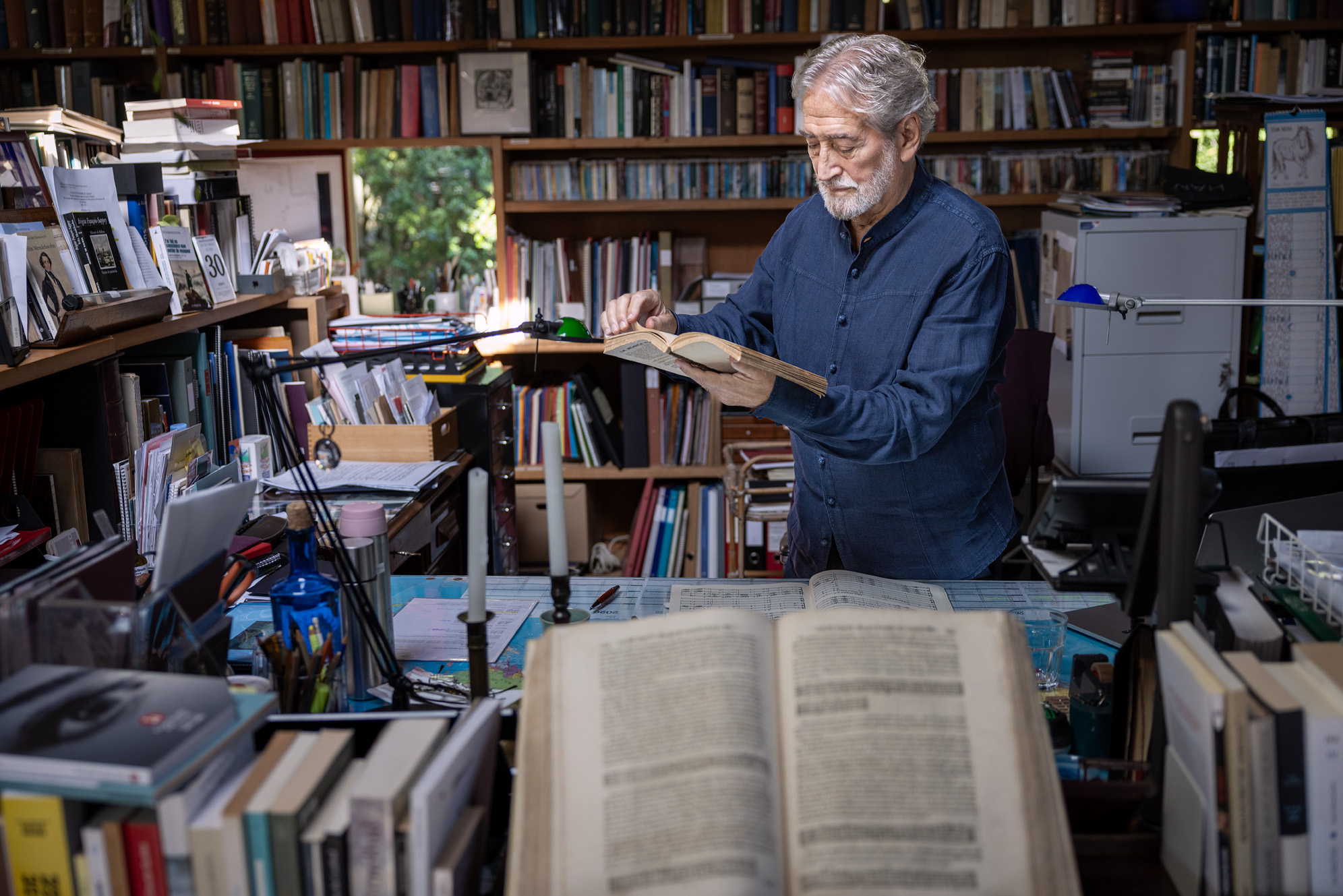
It was really a great coincidence that I came to early music. I had decided to play the cello. I was in a music shop in Barcelona and bought everything I could find for the cello. Schott Music, the publisher, had put together a collection of works for the cello, and in this collection there was music by Bach—the gamba sonatas—by Marin Marais Les folies d’Espagne, Diego Ortiz, and much more. A lot of music that was originally written for gamba. I studied this music and enjoyed it immensely. Later I completed the standard course of study—Beethoven, Schumann, etc., etc.—and at the end of my studies I took a course in early music and chamber music. The harpsichordist, my professor Rafael Puyana, said to me: “Jordi, you play so much music for the gamba. Why don’t you play the gamba, the viola da gamba?” So I wrote myself a note: look for a viola da gamba.
After returning to Barcelona, I was supposed to call someone back. I did: “This is Jordi Savall.” “Ah, Señor Savall: wouldn’t you like to play the viola da gamba?” I was invited to take part in a project with a very famous singer at the time—Victoria de los Ángeles—and to make a recording for EMI in England. They needed a professional gambist. And through a recommendation from someone who had heard me in concert, they knew that I played Bach’s suites very well and thought I might be interested in playing the viola da gamba. That’s when I acquired a viola da gamba and fell completely in love with early music. But the big decision came when I was at the Bibliothèque nationale de Paris. There, for the first time, I spent four days at a large table studying five books by Marin Marais, full of wonderful music. So much music—wonderful music. I then realized that none of this music was being performed. That was when I decided to concentrate on the viola da gamba and to put the cello aside.

You inspire many people with early music. What can early music still tell us today?
Early music fascinates many people today. This music allows us to understand other eras—in the sense of what those eras expressed in terms of emotions, cultic ideas, and ways of life. Elias Canetti said: “Die Musik ist die wahre Geschichte der Menschlichkeit.” [“Music is the true story of humanity.”] When you sing a melody by Bach, you are in Bach’s time; when you sing a troubadour song, you are in the time of the troubadours. And you are made to feel the same emotions as back then…if the singer is good [laughs]. Music is really a time machine. Through music, you can travel to any era, any country, any city. Today, this is a wonderful way to be inspired by other periods that are, in fact, totally outdated in our daily lives. We live in a world that is so far removed from the time of a Lorenzo de’ Medici, Louis XIV, or Bach—and the same is true of the music. In our completely crazy world, it is very rare and difficult to find the calm one needs in order to listen to this music.
What significance does contemporary music have for you? Do you see connections to early music?
The connection between modern music and early music, or the music of other eras, often depends on the way a composer writes. Very often it is a question of taste and artistic interest. Composers invented a new language that no longer had any connection to early music—at the beginning of dodecaphony, twelve-tone music, for example. That was a break. There was no longer any connection to folk music, nor were there melodies with repeating tones. A new language had emerged. But the language of many composers is different. I’m thinking, for example, of Arvo Pärt. After a ten-year pause, he found a new language. His way of composing is very close to early music.
We should not forget that today’s musical language in Europe originated in the 13th century with the Ars Nova. In the Ars Nova style, one melody is combined with other melodies. This was the origin of our European musical language. This art form was invented by young nuns in the convents at Las Huelgas, at Notre-Dame de Paris among other places. A language had emerged that all Europeans still understand—one that remains universal to this day. But in the time of Alban Berg and the Second Viennese School, composers devised a new language. It was not a language tied to one nation, but a free language. Around the same time, Esperanto was invented. That too was a language that was neither German, nor French, nor Italian, but a mixture of several languages. Esperanto did not succeed because no writer produced something truly fantastic in it and was eventually abandoned. In music, however, there were wonderful composers, allowing for real development. That’s why I think the connection between early and modern music is a question of the individual composer’s taste. There are composers who like to use motifs and ideas of the past, thus creating a wonderful mixture.
The program of the Prize Ceremony in Munich is titled Pro Pacem. From your perspective, can music have a peace-building function?
For the Prize Ceremony, I thought we should play a beautiful program with pieces that connect us to the idea of peace. One general idea of music is that it has the ability to calm us and bring us peace. Music cannot stop bombs or end war, but it can help resolve the war we carry in our hearts. Music is the only language that reaches our hearts directly. Without music, life would be impossible. Without music, one could not survive. I am deeply moved when I hear the old melodies from Armenia—so delicate and expressive—played on the duduk. Such beautiful melodies come from a land and a culture that has experienced such devastating situations, and they are passed down by a society that has faced immense difficulties in surviving.
I am convinced that all societies struggling to survive need music to keep hope alive. Think of Sephardic music. The Spanish Jews who were expelled around 1494 sang their songs for 500 years—every day. Because when they sang these songs with their families, they found peace and hope in their hearts. The same applies to Scottish immigrants in New York who, after hard work at the harbor, would meet in a pub, drink a beer together, play the fiddle, and sing their tunes. Thanks to this music, they were able to go on living. Without music, it would not have been possible. Music cannot end a war, but it can help us become more sensitive and have greater empathy for people who are victims of war.
This prize gives me the conviction that as long as there are people who grant such a prize, there is hope for a better world.
You have already received many awards and honors in your life. What does the Ernst von Siemens Music Prize mean to you?
It is true that over my long life I have received many prizes—from universities and from various institutions in France, England, and Italy. And yet it is a great joy to receive the Ernst von Siemens Music Prize, because this prize stands in a very special way for music and for a high level of quality. I see this prize as recognition of my many years of work: many years of rediscovering early music, many years of founding new ensembles, and many years of pedagogy and outreach. These were years in which I tried to make music a language that helps us improve as human beings. I am elated that an institution such as the Ernst von Siemens Music Foundation recognizes all of these elements. It is very important today to support those people who teach and introduce young people to music, making life better. This prize gives me the conviction that as long as there are people who grant such a prize, there is hope for a better world.

The interview took place on December 2, 2025, in Berlin.