Ernst von Siemens Music Prize 2025
Sir Simon Rattle
Laudation
Laudation for Sir Simon Rattle
Sir Willard White
Ladies and gentlemen, honoured guests,
I was deeply honoured, and even bowled over, when I was approached by the Ernst von Siemens Music Foundation to serve as the laudator for Sir Simon Rattle as he receives this prestigious award. A great man in this vast field of potential that being alive offers. I wondered what words I could find to approach fulfilling this brief.
I could just simply say he is awesomely brilliant. Oh no, just that would not fit the bill.
The sentiment of awe is shared by many who have had the privilege of working with Simon.
We know he was born in Liverpool. Wherever we are born influences, but doesn’t dictate what ensues.
Simon’s musical path began early with piano and violin lessons. A wider experience came from his father taking him to jazz concerts. I would have loved to have seen him, at age 10, playing percussion in the Merseyside Youth Orchestra, and then to quickly become their conductor. His early exploration of music revealed a quest for an identity that would define his career. I wonder if this was a conscious decision?
Oh, to have the courage to pursue what deeply moves us. I’ve had glimpses of how Simon’s journey was to become a remarkable one. Just imagine, at just 15, Simon formed his first orchestra, being able to involve some members of the Royal Liverpool Philharmonic.
Once more opportunity knocked, but despite doubts from influential figures, he entered the John Player International Conducting Competition and emerged victorious, earning acclaim. By 19, he became assistant conductor for the Bournemouth Philharmonic. At 21, he made his BBC Proms debut and graduated from the Royal Academy of Music, still questioning whether he would be a conductor.


It was in 1980 that our paths were to cross. One day my agent 53 told me about a ‘bright young’ conductor, with whom I should work: Simon Rattle. I had no idea who this man was…
When I first saw the slim, curly-haired young man, looking like a college student, I was not expecting what happened when the first downbeat came. From our first encounter, Simon’s passion and engagement were striking.
I recall a moment when a more mature musician challenged him; Simon’s choice was to acknowledge the challenge, but to respond with humour and musical reasoning, which left the challenger more enlightened than humiliated. I was witnessing Simon turning tension into collaboration, resulting in a noticeable, raised level of respect for the young conductor. Of course, I was impressed. I was curious as to what inspires and informs such a clarity?
It was not difficult to determine that I was in the presence of an exceptional artist. Is it possible to determine so quickly the exceptionality of an artist?
I would say that, when experiencing a total presence in each sound of the music, which allows a transcendence beyond words, this is exceptional. This type of experience does influence a change in my perspective of life. That is the privilege of art: to allow and experience these moments.
Simon’s 18-year tenure with the City of Birmingham Symphony Orchestra noticeably transformed the city’s profile. Later he spent 16 years with the Berlin Philharmonic and a term with the London Symphony Orchestra, bringing depth and innovation to each ensemble. His influence extends beyond his illustrious career; he is a champion transforming lives through music.
So, what is a conductor’s role if not to generate a transformative energy as the music comes to sound?
The soul, the essence of the conductor, is broadcasted. There isn’t a choice. What he is, or even thinks he is, is transmitted and the result can be called magical. This energy is palpable. Every gesture and word communicate a deep commitment to the music, that is, if indeed the commitment is present. The result is the respectful merging of commitment, courage, and authenticity without fear of vulnerability.
In my experience Simon embodies this spirit. He is clear with what he wants and manages to encourage the players before him that their commitment level can be the same as his. For me, it is this dedication which has shaped his remarkable journey.
One summer during the Glyndebourne Festival in England we were all to feel the transformative power of music during a collaboration with Simon, on Gershwin’s Porgy and Bess. The experience was nothing short of inspiring. Lives were changed, evidenced in the entire Glyndebourne Festival and surrounding community. Mine definitely included.
I once met a young South American musician who wished to tell me that, through Simon’s work and guidance, he rose from being a street child to become a member of a renowned symphony orchestra today.
Nothing is to be taken for granted, young people are encouraged in critical thinking and curiosity, motivating their passions to be pursued. Through collaborations with contemporary composers, Simon enriches the orchestral repertoire and encourages musicians to embrace modern music.

Simon’s numerous awards, including a Knighthood in the Uk and 55 Germany, and the Léonie Sonning Music Prize, are a few that reflect his acknowledged cultural contributions. Yes, there are many more but even so, they have not changed the essence of the man Simon Rattle.
In conclusion, the lingering question would be, why become an artist? What is the inside deep motivation? I would say that it is the continuous transcendence toward the self I dream of being, to touch another part of my self, higher and deeper. Each time I see Simon conduct, I see a metamorphosed man, in full commitment to the absolute present. His legacy is not just in the music he conducts but in the countless lives he has touched and the future he has inspired.
Rewards continue to be manifested. It is a great honour for me to know him.
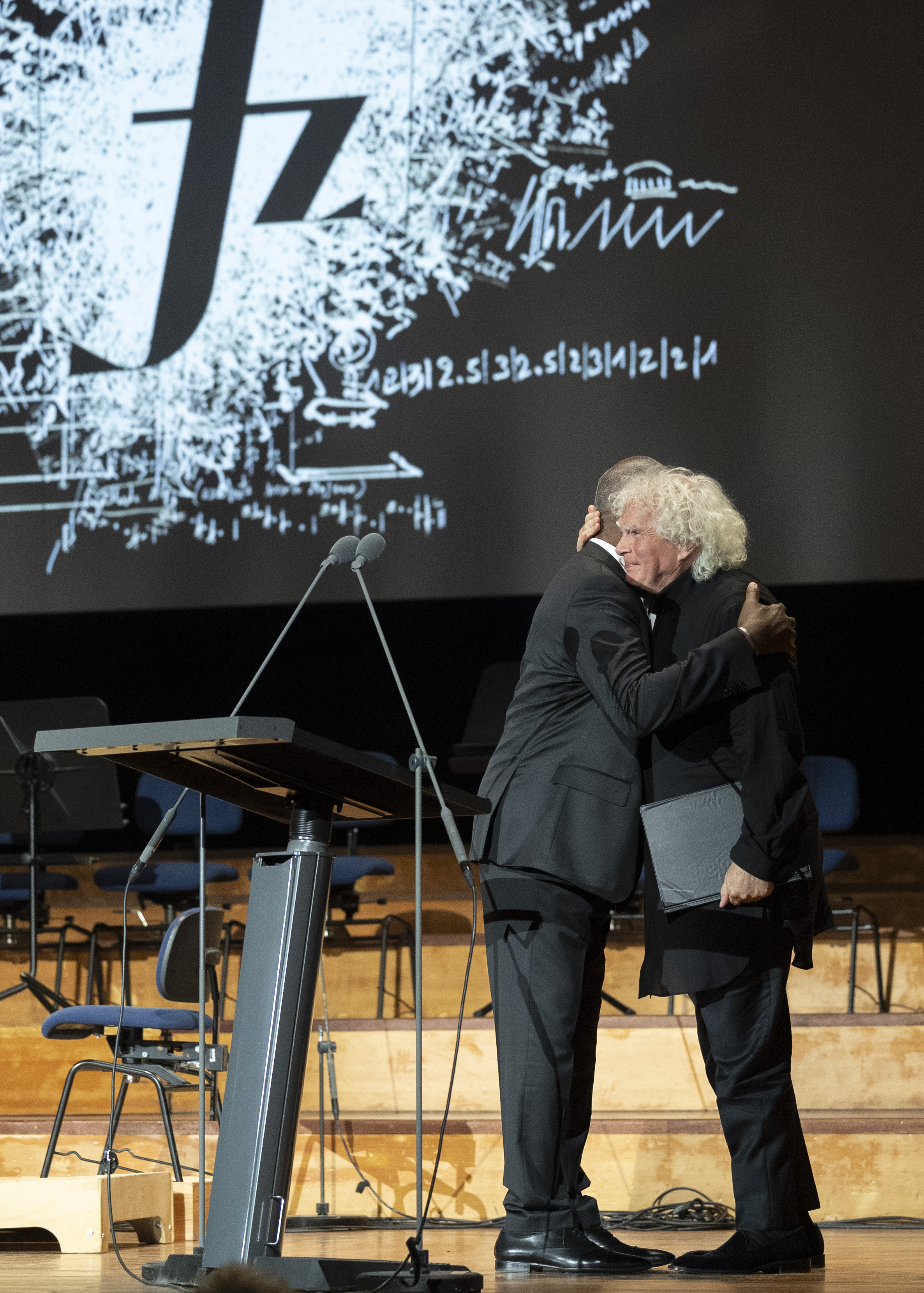
Heartiest congratulations, Sir Simon.
Thank you.
