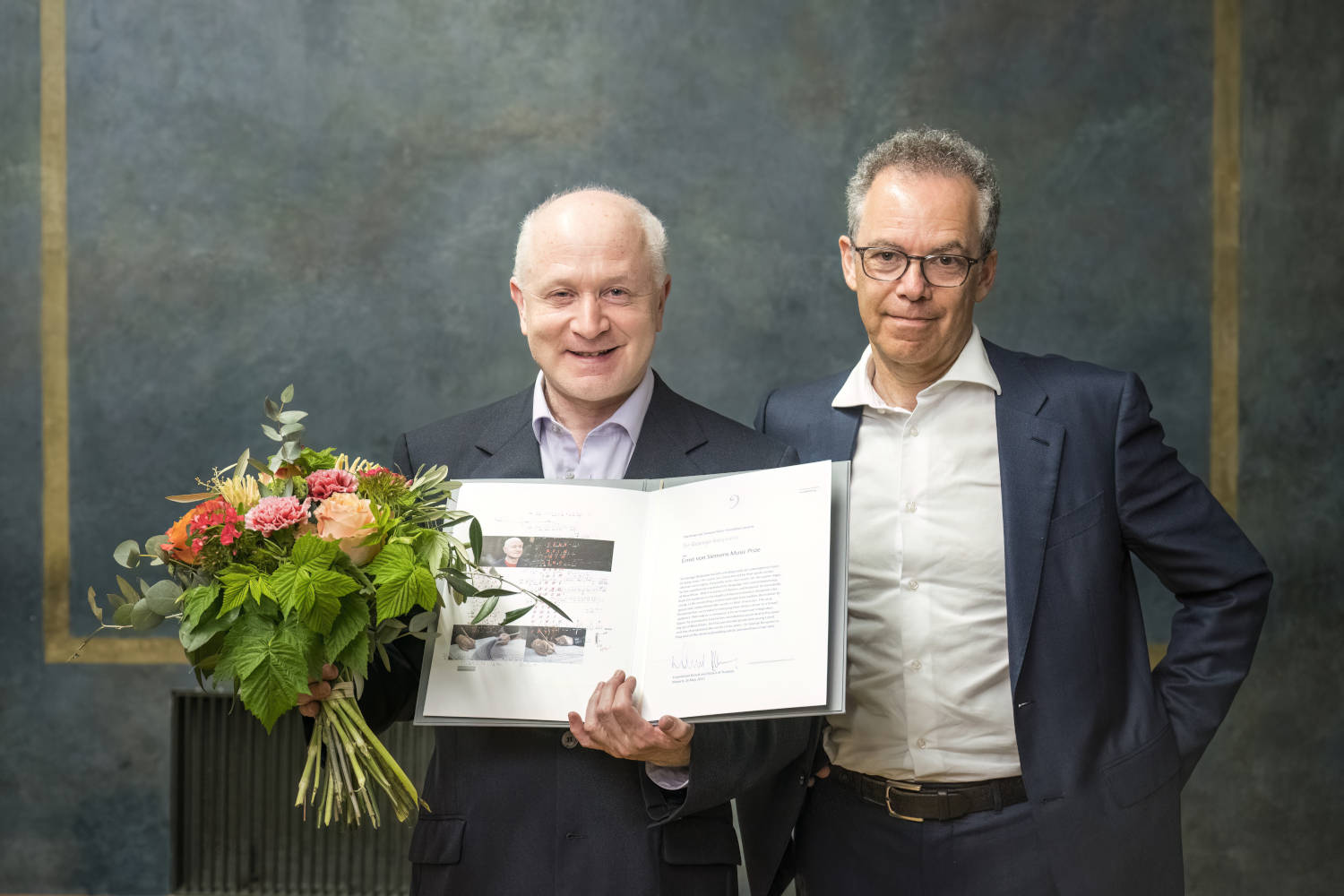
Ernst von Siemens Music Prize 2023
George Benjamin
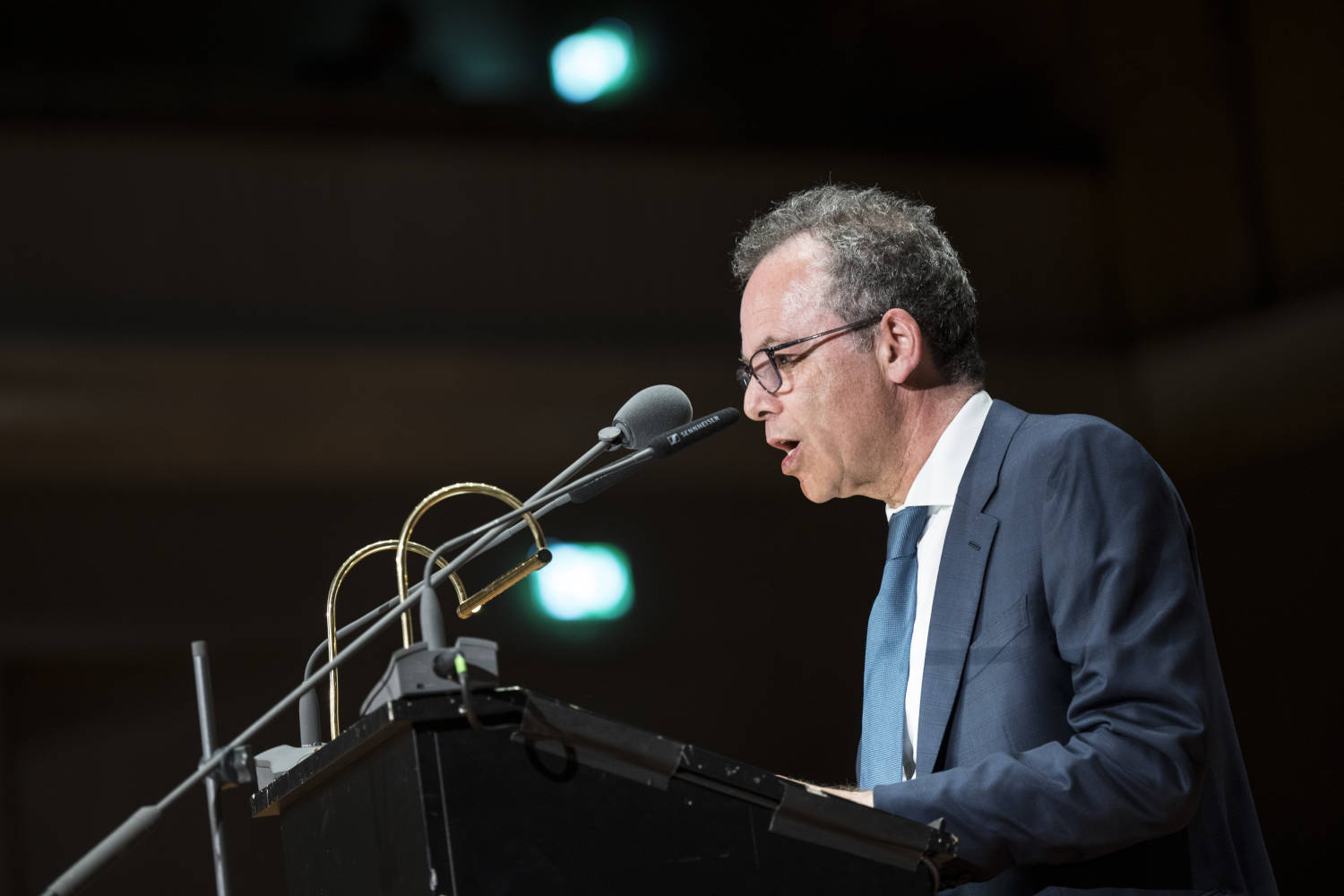
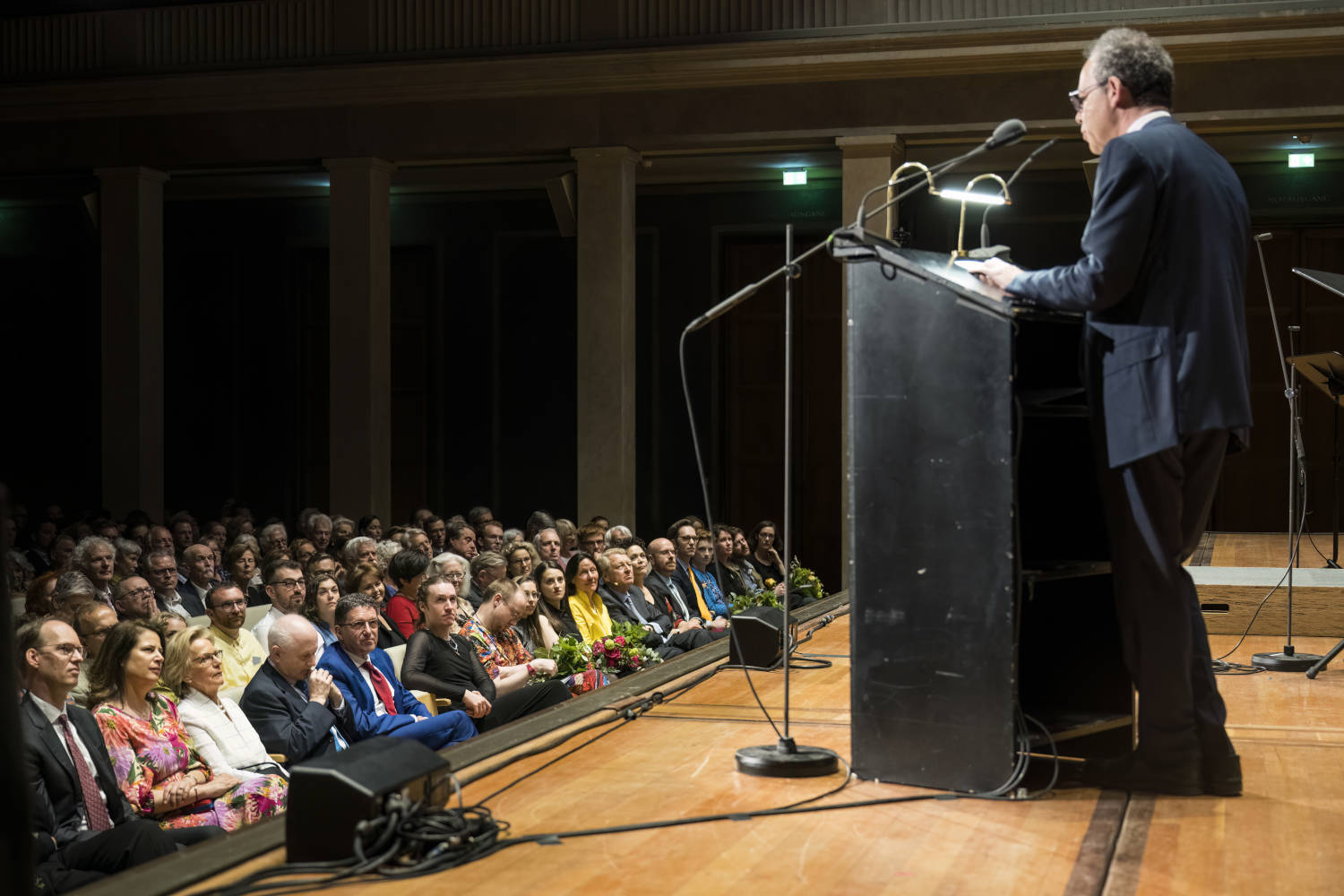
Laudation
Laudatory speech for Sir George Benjamin
by Johan Hyman
Sehr geehrte Damen und Herren, Dear Ladys and Gentlemen,
George and I have been friends for fifty years and music has of course been a constant part of our friendship. But I am not in any sense a musician. Someone at the Ernst von Siemens Music Foundation—possibly someone with a sense of humour— decided that this was not a bar to delivering the laudation at this magnificent event.
Perhaps they thought that somewhere away from the glare of the limelight, George might have accidently let slip a secret key or clue to the mysterious process of composition, a glimpse into his creative process, which revealed how the magic happens.
Well, if that is the reason, why I was invited I am pleased to say that I can oblige.
In the last few years, apart from meeting for supper or to watch a movie, or occasionally to attend a concert, I’ve met George at a children’s playground where I take my four-year-old son David on the weekend. George and Michael live five minutes’ walk away and sometimes join us. This is where the secret was revealed.
Among the many wonderful slides and swings and climbing frames—there are three robust musical instruments made of stainless steel, planted securely in the ground: tubular bells, suspended from a frame, a metal drum, and a glockenspiel. My son David was having a bash at the glockenspiel. In idiomatic English, having a bash at something means trying it out, but I am using the phrase literally.
So, George wrenched one of the mallets out of his grip and David held on to the other one, and they played together. George gave the instructions. “Just the high notes”, he said, “only play the high notes”. So they played the high notes for a little while, and then George said, “Now just the low notes”, and they played just the low notes for a while. Then the high notes, then the low notes again. And then at last, when they’d gone back and forth between the high notes and the low notes several times, George said “And now—only now—the middle notes. Notes they haven’t heard for two minutes. That’s the trick of composing!”
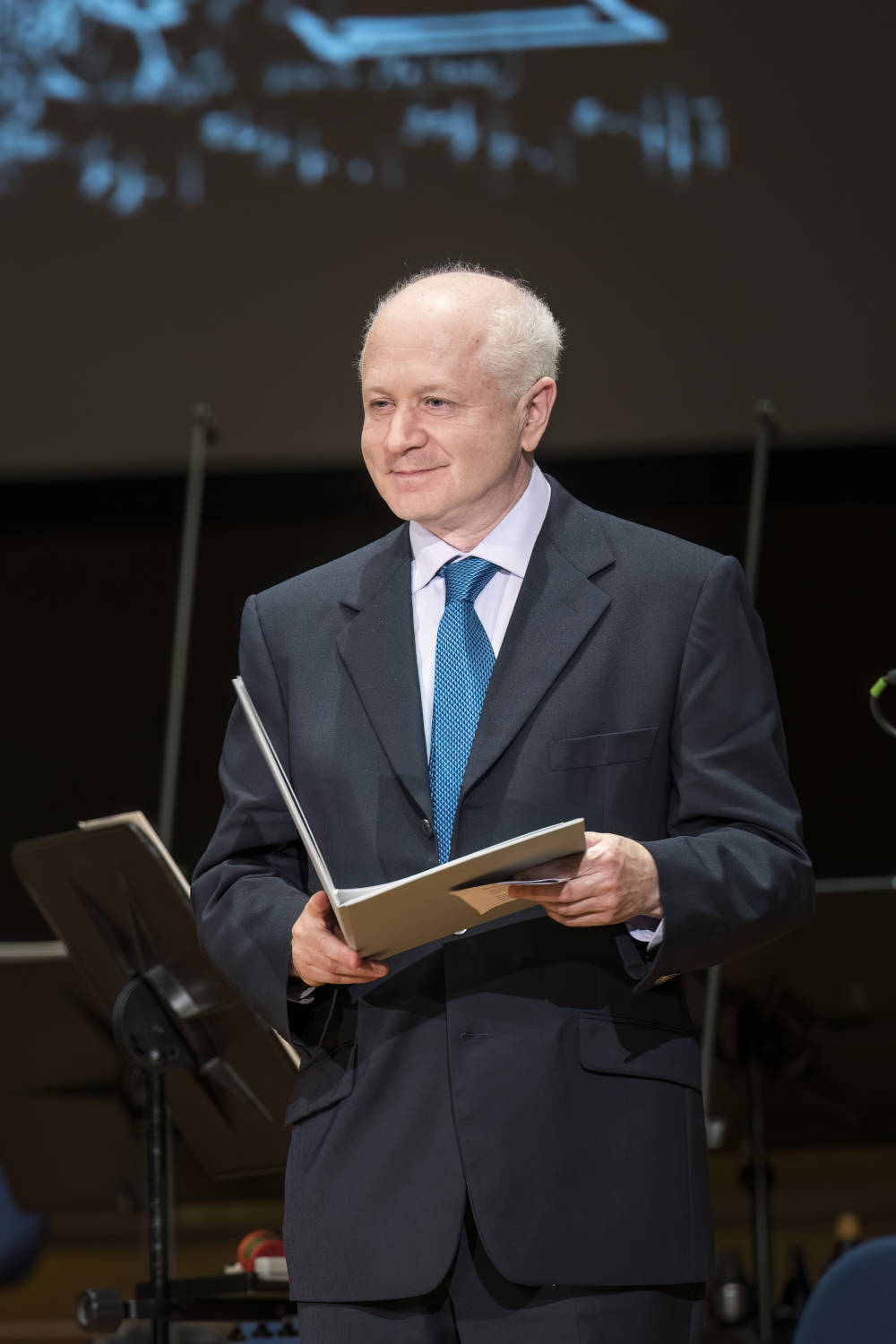
I was thrilled to learn that George was to be awarded the 50th Ernst von Siemens Music Prize, but it did not come as a surprise. The Foundation cannot have been courting controversy when they made this choice. Because George’s contribution to music—as a composer, conductor, performer, teacher, and broadcaster— is unparalleled in Britain and probably in Europe today.
Naturally, it has many roots. It’s rooted in George’s uncompromising devotion to his craft; his unalterable conviction that the beauty of music can transform human experience in a unique way; his ability to articulate his thoughts and feelings about music with complete sincerity and precision; his alarming mixture of gentleness and perfectionism; his passionate sensibility; his integrity; and the fact—as a mutual friend put it—that he has a humungous pair of ears.
George’s teacher, the great French composer Olivier Messiaen, explained this important fact about George’s ears more prosaically. When he met George—who was sixteen at the time—and examined the music George had already composed, he saw, as he later put it, that “in everything he wrote the harmonies were heard, the textures were heard, there were no mistakes, he heard everything. I thought immediately that he was like the young Mozart; the young Mozart heard everything.”
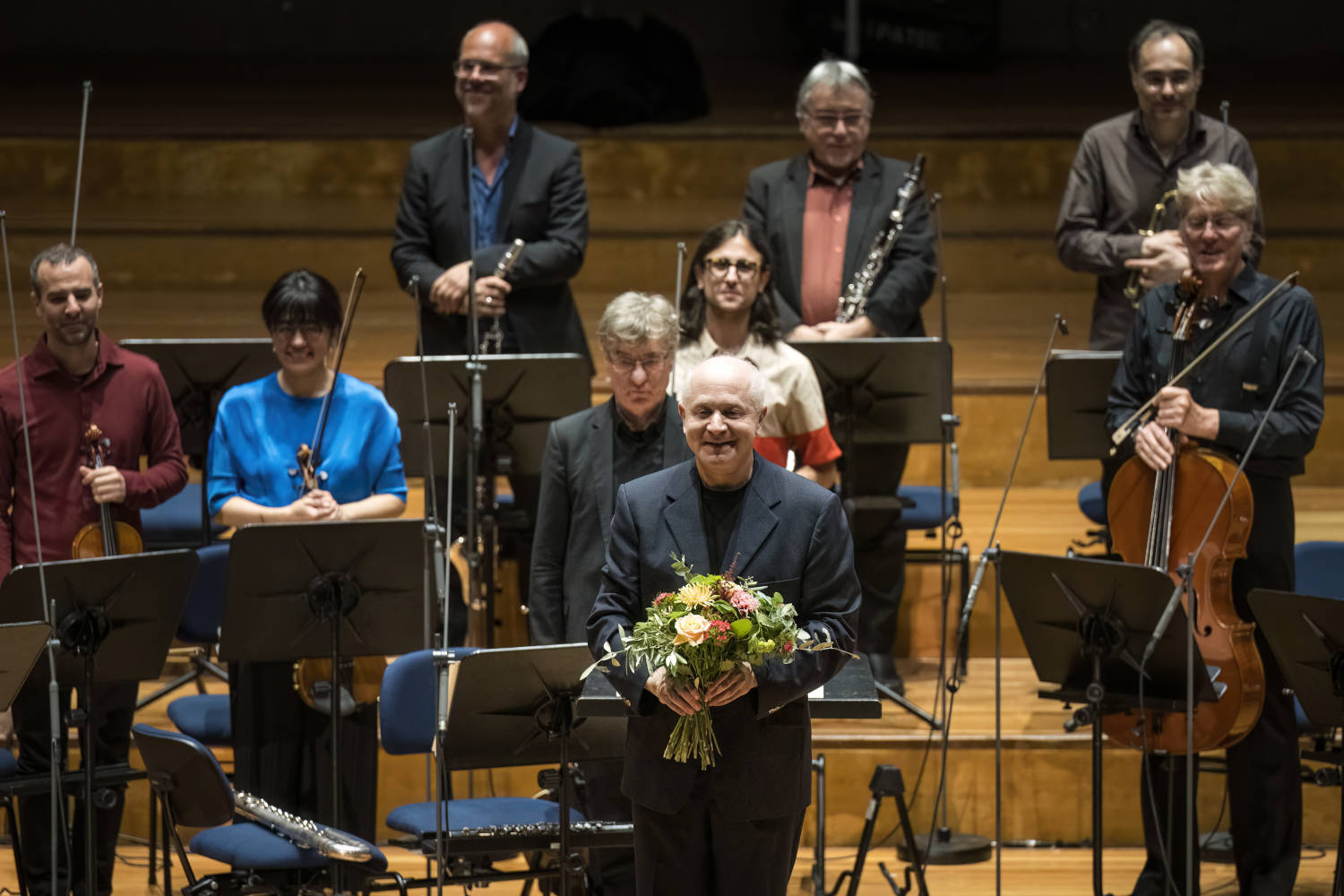
Being like the young Mozart at the age of sixteen can be a curse rather than a blessing, and it takes several of the other qualities I have mentioned—perhaps integrity above all—to ensure that this is not the case. It also takes wise parents and teachers, which George was fortunate to have.
Now I should like to say a few words about some of the qualities I have mentioned—some but not all.
The beauty of music and its magical effect on our sensibility has always been an axiom for George. Here he is speaking a few years ago about a concert he had attended fifty years earlier, in the 1960s. These are George’s words:
“My very first orchestral concert included Debussy’s L’après-midi d’un faune, which remains one of my favourite pieces ever written, and I can recall very clearly the moment that extraordinary, luscious, beautiful, deeply poetic piece starts. I can remember the temperature and the atmosphere in the fairly new Festival Hall altering, changing, as if someone had turned the heat up two degrees. This is one of the magical things about music. It changes more than the atmosphere, it can change one’s perception of existence, it can change the way you sense and feel, while you’re listening to it.”
I like this remark because George celebrates music for what it is. When poets and philosophers—I’m afraid I do have German Philosopher’s mainly in mind—when they tried to explain the power of music, they generally done so by transforming music into something else: revelation, metaphysics, an intimation of transcendence, the embodiment of the Will.
Always something more obscure, and less beautiful and affecting, than music. Beethoven once described music as “the one incorporeal entrance into the higher world of knowledge.” But this way of thinking about music is—how can I put it with due reference—it is a mistake. As a clever philosopher pointed out, “it makes much better sense to conceive of the blessedness of the saints as a sort of prolonged musical ecstasy than to conceive of the pleasure of music as a fore-glimpse of the blessedness of the saints.”
I do not believe George was ever tempted to intellectualise music in this way. His devotion to music has always been to music as music, not music as ideas, or music as transcendence, or music as anything else.
And this brings me to George’s devotion to his craft. I cannot speak with authority, but I believe George approaches each composition with no preconceptions and no rules, without an established idiom or method. Each piece inhabits a new world of sound, freshly created, with its own atmosphere, its own colours, its own laws.
This demands an immense amount of preparatory work, vastly more than the listener hears or imagines. It is documented meticulously and rather beautifully with pens and coloured pencils, in notebooks and sketchbooks, an exhaustive process that permits the music in each piece—with all its beauty, its dazzling texture, its emotion and violence and charm—to unfold with the inevitability of clockwork and the freedom and unpredictability of the wind, and with complete integrity, so that nothing is inessential, meretricious, or mere gesture.
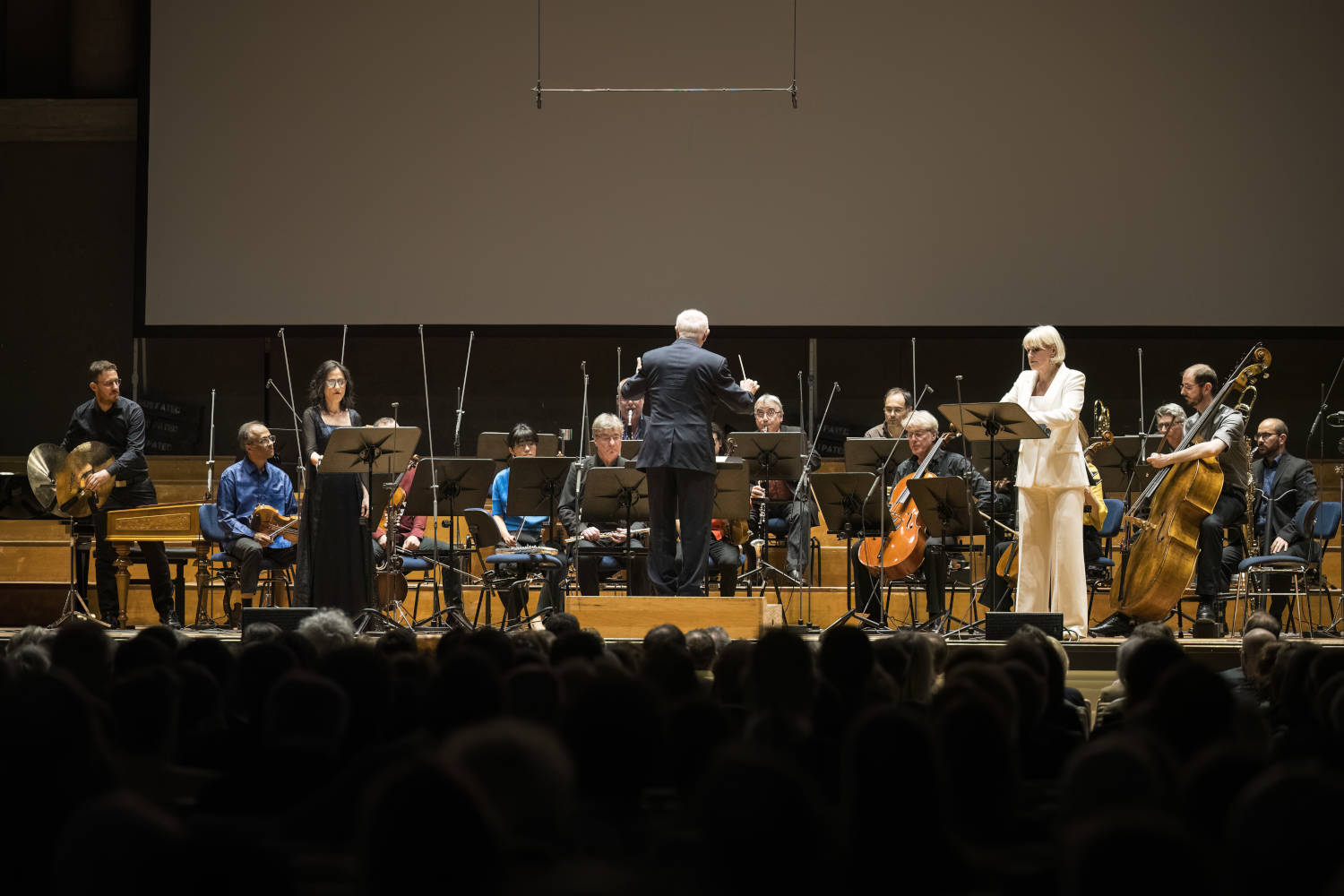
Finally, I shall say something about the operas.
George was already a dazzling orchestral composer when he turned to opera—At First Light was composed when he was scarcely out of University—and he already had a special gift for melody, and for the voice. But the unforgettable voices in A Mind of Winter, Upon Silence, and Sometime Voices are solitary, and they soliloquize with a sustained mood and a single, magical, perspective on the world. The beautiful melismatic voice in Upon Silence, which I particularly love, is deliberately distanced from the world of activity and conflict and sings about that distance.
In the mid-1990s, George said that he would like to write an opera but added ruefully that he might not be cut out for collaboration. He met Martin Crimp ten years later and the operas followed—the texts deliberately laconic and detached, the music ravishing, poetic, and profound. Opera houses were always designed to stage love and violence; but these operas present them with such raw beauty and intensity that we seem to be seeing them enacted for the first time.
A laudation is an unusual kind of speech—a eulogy for the living, with the subject present in the room. The only speeches of this kind I have heard were at the Encaenia—the ceremony in which Oxford University bestows honorary degrees. And those laudations had the great advantage of being in Latin, which spares everyone involved embarrassment. It doesn’t even matter terribly much what the speech contains, since constructing a Latin phrase that means “contribution to solid state chemistry” or “haunting piece for glass harmonica and viol de gamba” is already such a remarkable achievement in itself.
Nevertheless, I am very grateful for this opportunity to express my affection and admiration for my supremely gifted friend, and to congratulate him on the award of the Ernst von Siemens Music Prize.