
Ernst von Siemens Music Prize 2024
Unsuk Chin
Laudation
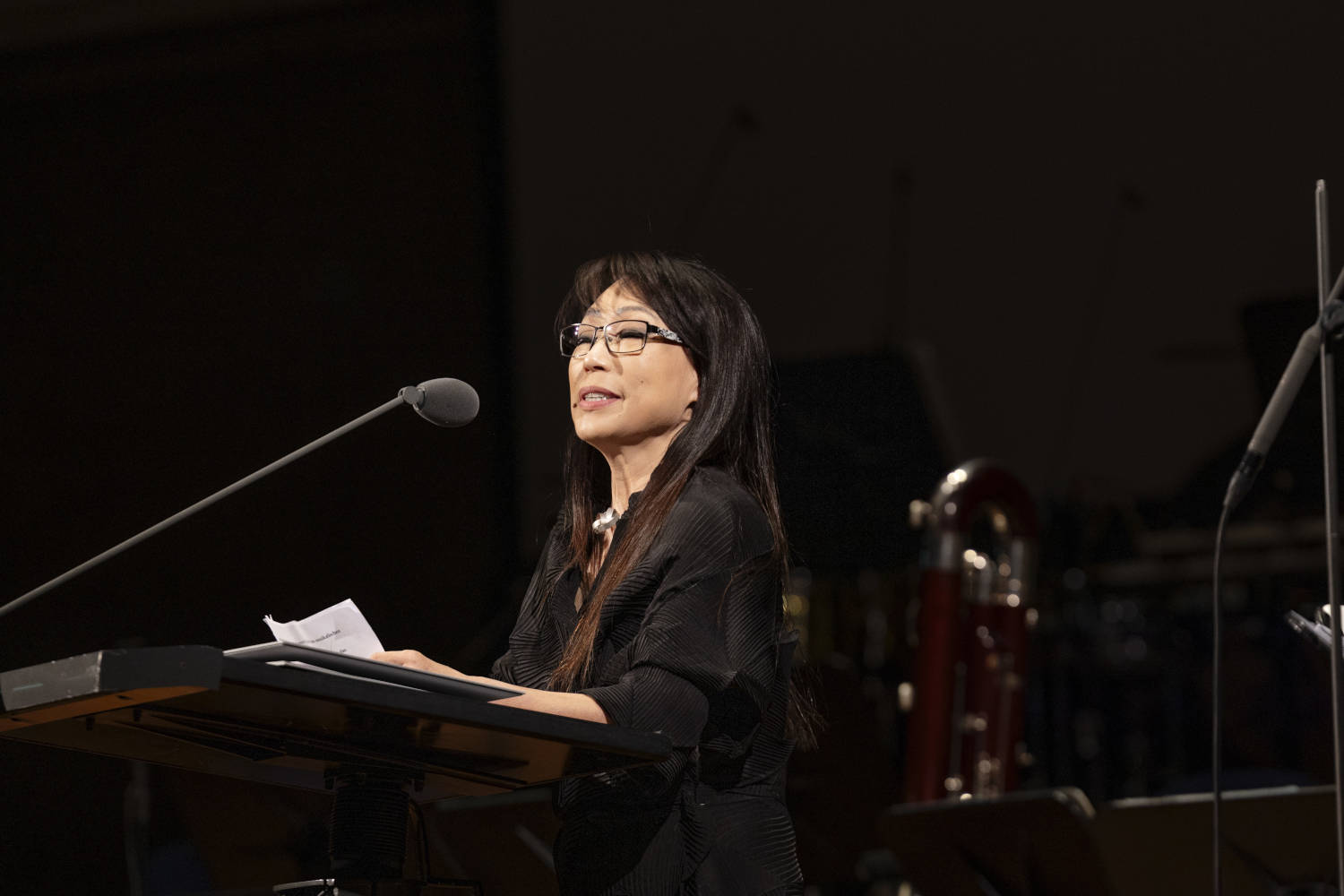
Laudatory speech on Unsuk Chin
by Louwrens Langevoort
Dear von Siemens family, ladies and gentlemen of the Foundation Board, the Board of Trustees, the head office and the team of the Ernst von Siemens Music Foundation, dear Unsuk and dear ladies and gentlemen. A laudatory speech for Unsuk.
Tell me who I am
In the beginning was the fairy tale. Unsuk Chin’s breakthrough as a composer came with Akrostichon-Wortspiel, which was based upon Michael Ende’s fairy tale The Neverending Story and Lewis Carroll’s Alice Through the Looking Glass. The character of Alice remained a key source of inspiration: Chin’s opera Alice in Wonderland premiered in Munich in 2007. Fairy tales, the world of dreams, the suppression of reality – is this where Unsuk Chin’s universe takes shape? Alice in Wonderland tells the story of the young girl Alice, who one day sees a talking white rabbit staring at a clock, thinking it is going to be late. The girl follows it and suddenly falls down a deep tunnel, ending up in a world of complete fantasy populated by talking animals and people who parody the adult world. A classic text that features in every old-fashioned upbringing. Various sentences from the libretto – written by David Henry Hwang and Unsuk Chin – now introduce us to the diverse aspects that have shaped Unsuk Chin’s oeuvre. Origins, dreams, sounds, theatre and nonsense …


Tell me who I am
Born in Seoul, Unsuk Chin grew up with music; when she was still very young, her father already taught her how to play the organ and the piano in their church. Music as the centre of a growing girl’s life. Her wish is to become a piano virtuoso, but this is a path she realizes she cannot follow. One of her teachers advises her to compose. At a mere twelve years old, she writes her first pieces and gains experience as a self-taught composer. She takes the music academy entrance exam three times and is accepted the third time, becoming the school’s model student in no time at all. Years later, in an interview, she answers the question of what advice to give today’s students who want to become composers: “You can’t make a living from composing alone, but if you can’t do anything else, well, you just do it …”. Unsuk Chin learns the most from the deceased tone poets: Bartók, Stravinsky, Debussy, Webern. In Korea, she takes lessons with Sukhi Kang. In Hamburg, she remains in Ligeti’s class for four years… She is well-versed in early music and the techniques that were used and taught in earlier times. Influences from Asia, whether Korean or Balinese Gamelan music, everything is studied in great detail and resurfaces in her compositions in its own special way. In Berlin, she embarks on a profound exploration of electronic music and spends countless hours in the studio. Thus she is familiar with the genesis of every sound – creating her own world.
Tell me a story
Composing can be a lonely profession. You work alone, you wrestle with the material. Where does inspiration come from? “My music is the image of my dreams. In all my dreams, I see visions of immense light and incredible splendid colours; I try to depict these visions in my music as a play of light and colour flowing through the space and simultaneously forming a vivid sonic structure whose beauty is very abstract and aloof, but precisely because of this appeals directly to the emotions and conveys joy and warmth.” For Unsuk Chin, every composition is a long struggle. She does not compose at the piano, spends a lot of time on preparatory work, and her first sketches resemble large, richly coloured, quasi-abstract paintings on music paper. These sketches are in fact stunningly beautiful. During an exhibition of her work at the Acht Brücken Festival in Cologne in 2017, one of the patrons came up with the idea that these sketches could be used for a new kind of art to trade with – an idea that was unable to prevail, however. “Then I sit down and start with the first note. I write chronologically, I can’t help it. It isn’t possible for me to create other parts first, because for me the development can only be in the right order.”
Take care of the sense and the sounds will take care of themselves
Unsuk Chin has an extensive catalogue that spans all musical genres. The composer has made only a few of her earlier works public. She regards this period as her years of apprenticeship and has withdrawn most early works. This makes Die Troerinnen (Trojan Women) (1986) for three female voices, female chorus and orchestra her first official work, followed by Gradus ad Infinitum (1989) for four-channel tape, both of which were published before her breakthrough with Akrostichon-Wortspiel.

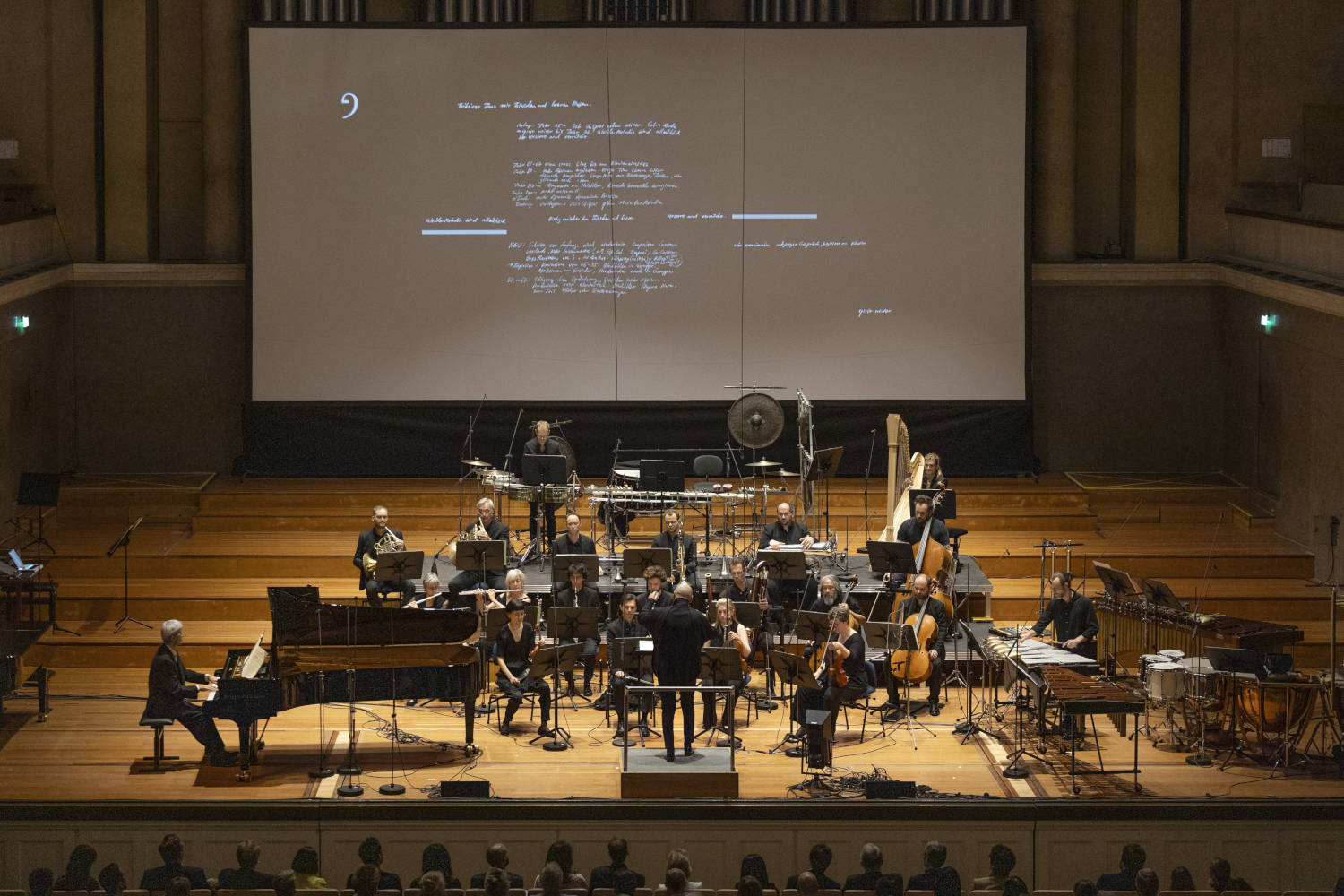
In the years leading up to the millennium, her musical language slowly developed. What are we to understand by this language? Unsuk Chin’s music is characterised by a great versatility, a constant development not just in terms of colour, but also in terms of complexity. Six Etudes for Piano, written in the 1990s, represent this development in a nutshell. These relatively short works have become highlights of the pianistic repertoire that no soloist can ignore. The etudes are followed by a piano concerto. Chin writes a total of six solo concertos for piano, violin, cello, clarinet and sheng as well as a double concerto which we will hear later. Chin’s musical language becomes ever more profound in the orchestration of her later compositions. The colour of the different orchestral instruments gives each work its own characteristic profile, forcing you to listen and imposing its beauty on the audience. Listeners do not always have it easy, for the scores feature a lot of movement and development – every time you listen to Unsuk Chin, you experience something new, discovering and enjoying fresh aspects of a given composition again and again. From solo pieces to ensemble works, her development culminates in works for large orchestra, where she displays consummate mastery of musical colour. Her language cannot be pigeonholed, neither in terms of style nor in terms of a local region. Characteristics: the high strings that never come to rest, plucked sounds, high agitated winds, high metallic entries of the bells and an unstoppable energy that emerges from the rapidly alternating figures of the various orchestral groups. Chin’s reverence for the past has long since given way to a style of her own, which draws on the joy of music from the global here and now. Unsuk Chin’s music sometimes comes at you like an ocean wave, but it does not drown you. Listeners come away from the experience energized, purified and immediately demanding more. Her music is addictive.
Everything has a moral if you can find it
And there is still room for fairy tales: Chin’s main work is undoubtedly the opera Alice in Wonderland, which premiered in 2007 and is based on Lewis Carroll. Here, she is able to draw on her boundless love both of theatre and of the bizarreness of the world. In Alice, Lewis Carroll very consciously breaks with reality, creating a tale that links human beings and animals and of course severely criticizes his own “normal” world. While Colette and Maurice Ravel’s operatic fairy tale L’enfant et les sortilèges can still be seen as written with affection for its main character, Alice is much less sentimental. Animals question the protagonist and do not always mean well, and the human beings in Wonderland are nasty almost without exception. Unsuk Chin wrote the libretto herself together with the writer David Henry Hwang. The two authors opt for a less common form of theatre; Lewis Carroll’s story is still present, but the theatrical form is very free. Unsuk Chin’s brilliant music makes congenial use of a combination of singing, speech-song and speaking – the large orchestra is present, sometimes threatening in its strength and aggressiveness, sometimes, as in baroque theatre, represented only by individual instruments that enter into a lyrical musical union with the singer portraying Alice. The opera is both musically moving and frightening due to the cruelty of the human court society it depicts. The tea party evokes the LSD trips of the 1960s – a connotation that Lewis Carroll probably never dreamed of in the slightest.
But it is not just on stage that Unsuk Chin’s addiction to the theatre manifests. Various works illustrate just how much the theatre of everyday life captivates, fascinates and inspires her. She herself writes of the encounters she had in China when suddenly, out of nowhere, a street theatre troupe was standing before her, giving a performance in a public space. It reminded her of her own youth in the still impoverished city of Seoul, where similar troupes gave performances. The five movements and prologue of this 2011 work called Gougalon need no stage, for the music already gives us all the means we require to vividly imagine the situations it depicts. Her new opera will continue on this theme – naturally, we are all eagerly awaiting its completion next year!

Unsuk Chin also sometimes demands histrionic qualities of her musicians. In Allegro ma non troppo for percussionist and tape, various sounds were first recorded: tissue paper, clocks, drops of water. These sounds were then subjected to numerous transformations and overdubs. In the performance, the percussionist and the tape merge into a single instrument. The player enters into a dialogue with the virtual drummer, playing not on standard instruments, but only on everyday objects … Musical theatre without words on one square metre.
Nonsense and prevarication: there is certainly meaning both in and out of it
The imagination knows no bounds and, as already mentioned above, takes its inspiration from dreams and fairy tales. The human voice is pivotal to Unsuk Chin’s imagination. It is represented in many of her works, both for ensembles, for orchestra, and of course in opera. For Unsuk Chin, as she herself says, vocal music is not about “… setting poems to music that convey specific content or feelings. Music and literature are ‘languages’ that each follow their own rules and that often get in each other’s way when combined.” To this end, in Chin’s works, text is transformed, fanned out and pulled towards humour and irony. Cantatrix Sopranica is a masterpiece of these transformations. The composer develops half of the texts of the work’s eight movements herself; for the other four parts, she adapts and distorts material by other writers.
Cantatrix Sopranica is a reflection on singing itself, on the specific sensitivities of singers, their tricks and tics and their self-projection. At times it descends into absolute nonsense, with the narrative taking place in the listener’s imagination. Is it an escape from reality…? Or an extension of the fairytale, of the fairytale-like?
Be what you would seem to be
The last word goes to the composer herself, of course: the wrestling with the material, the solitary labouring over sketches and score pages come to an end and the piece is finished. The musicians are given the sheet music and can start rehearsing. How will they react…? Will they like the music, will they understand what is written there? They very probably will. For Unsuk Chin herself says that her music is a reflection of her dreams. Even as a child, she “often had very vivid dreams, with lots of light and colour, of outer space, the cosmos or exploding stars”. And she translates this colour and vision into her compositions. These dreams take me back to the beginning and to the story of Alice in Wonderland.
I would like to conclude with a quote that applies not only to Unsuk Chin’s music and our experience of listening to it, but to our actions in the present, too: Alice: “Would you tell me, please, which way I ought to go from here?” – “That depends a good deal on where you want to get to,” said the Cat.
Congratulations, my dear Unsuk!